top of page
SARAU
DAS COPAS
SARAU
DAS COPAS
SARAU
DAS COPAS
SARAU
DAS COPAS
Próximos Eventos
Email
Email
Parceria com o Teatro Popular de Ilhéus
Email: observatorio@uesc.br
Telefone: (73) 3680-5621
Efemérides
Efemérides
Efemérides
Palestras
Palestras
Os registros de passagem dos astros
Os registros de passagem dos astros
Converse com um Astrônomo
Converse com um Astrônomo
Palestras
Palestras
Os registros de passagem dos astros
Converse com um Astrônomo
Converse com um Astrônomo
Home
Observação
Céu Aberto
Visita ao Observatório
Agendamento
Como chegar?
Escolas
Atividades
Planetário Inflável
Recurso para Professores
Papo Astronômico
Certificados
Produção
Sarau das Copas
Circo Celestial
Cometa Ciência e Arte
Músicas Temáticas
Nossos Vídeos
Paisagens
Jogos Didáticos
Palestras
Astroteca
Livros
Cursos e Oficinas
O que tem no céu?
Para as Crianças
Sites
Softwares
Vídeos
Eventos
Programação do Mês
Efemérides
Luas do Mês
Eventos Ofertados
Galeria
Fotos
Vídeos Visitação
Expressões
Institucional
O Projeto
Equipe
Infraestrutura
Mais
Use tab to navigate through the menu items.
Contato
Fotos do Dia
Astrofotografias
Astrofotografia
Tudo por uma Bela Foto
Astrofotografias
Reproduzir vídeo
Reproduzir vídeo
04:57
NOX ATACAMA II | 8K60
Home to the darkest and cleanest skies in the world, the Atacama Desert offers views to the nightsky like no other. 2 years after the very successful first video "Nox Atacama" we return to this magnificent region and get rewarded with uncountable numbers of stars and fantastic nebulae in one of the most quiet a empty places on earth. Not a single noise distracts from the grand show the nightsky has to offer. Filmed over a month in Mar/April 2019, I worked in freezing temperatures, altitudes up to 5200m/17000ft, salt lakes and icy slopes. The Atacama is not welcoming to life and equipment. The lack of oxygen makes it tough to get anything done in these high altitudes. But it provides without doubt for epic and vast vistas of one of the greatest landscapes on earth. SPECIAL THANKS to Angelbird Media for supporting this project with their storage solutions: https://www.angelbird.com/ BUSINESS-CONTACT: martin[@]timestormfilms.net STOCK FOOTAGE: https://timestormfilms.net/portfolio-posts/atacama-stock-footage/ WEBSITE: http://www.timestormfilms.com INSTAGRAM: https://www.instagram.com/martin_heck/ MUSIC: “Back to Earth” and "Gamma Ray" - Hector Posser EQUIPMENT: Cameras: Nikon D850, Sony A7RIII, Sony A7RII Lenses: Zeiss Otus 28mm f1.4, Sigma 14-24mm f2.8, Sigma 14mm f1.8, Canon 11-24mm f4, Sigma 50mm f1.4, Canon 70-200mm f4, Tamron 100-400mm Motion-Control: eMotimo Spectrum ST4, Dynamic Perception Stage Zero, Vixen Polarie Star Tracker
Reproduzir vídeo
Reproduzir vídeo
02:58
Behind the Scenes of Nox Atacama II
Have a look behind the scenes of a one month journey shooting Nox Atacama II in the Atacama Desert. One of my cases with tripods, warm clothes etc was lost by the airline when I went there (it got found after I got back home). I run my slider on steel curtain rails instead of slick carbon-fiber rods. The conditions were harsh, the air thin, and the nightsky absolutely mind-blowing. I shot 120000 8K RAW photos, 6TB in total. It took another month of 24/7 rendering to bring those into playable video clips. But all that was clearly worth it in my opinion: https://www.youtube.com/watch?v=V6TqGLBY4hI SPECIAL THANKS to: https://www.angelbird.com for providing me some very nice portable SSDs on this trip www.wickedsouthamerica.com for the very nice 4x4 camper http://share.mscbd.fm/martinheck
Reproduzir vídeo
Reproduzir vídeo
03:15
Observatories | La Palma - ORM 4K
Part three of a series of journeys to the big astronomical observatories of this planet. La Palma, a beautiful and remote island of the Canary Islands is home to one of the worlds biggest and most diverse observatories. The "Roque de los Muchachos Observatory" contains jointly the telescopes and instruments of about 60 institutions from more than 20 countries. But beside the modern, scientific research that is being done here, this place also as a rich history of the native population as place to observe the stars. Petroglyphs confirm that there have been astronomical observations thousands of years ago already. Filmed and edited by Martin Heck: https://www.timestormfilms.com/ Filmed for the documentary "Star Stuff" by Milad Tangshir (milad.tangshir@gmail.com). Check out the trailer: https://www.youtube.com/watch?v=F7Vp5waD4i8 Produced by Davide Ferrario: http://www.rossofuocofilm.it/produzioni.htm Music: by Generdyn http://share.mscbd.fm/martinheck Shot in Summer of 2016 on the Island of La Palma GEAR: Cameras: Sony A7RII, Sony A7s, Canon 6D Lenses: Zeiss Otus 28mm f1.4, Zeiss Milvus 35mm f2, Tamron 15-30mm f2.8, Canon 11-24mm f4, Canon 70-200m f4, Canon 24-105mm f4 Motion-Control: eMotimo Spectrum ST4, Dynamic Perception Stage Zero slider Edited in LRTimelapse, Lightroom, After Effects and Davinci Resolve
Reproduzir vídeo
Reproduzir vídeo
05:20
Observatories | Chile ESO Paranal and ALMA | 4K
Part two of a series of journeys to the big astronomical observatories of this planet. In this video: The Paranal Observatory and the Atacama Large Millimeter Array - ALMA. With some of the biggest ground-based telescopes on earth, the observatories of the European Southern Observatory in Chile are at the bleeding edge of astronomical research. These incredibly complex machines, operating synchronized and precisely in the very remote and hostile environments of the Atacama Desert and Andes, enable deep views into the universe. All the sequences were shot in only 4 nights in total, but on two trips in 2017 and 2019. Filmed and edited by Martin Heck: https://www.timestormfilms.com/ Paranal scenes filmed for the documentary "Star Stuff" by Milad Tangshir (milad.tangshir@gmail.com). Check out the trailer: https://www.youtube.com/watch?v=F7Vp5waD4i8 Produced by Davide Ferrario: http://www.rossofuocofilm.it/produzioni.htm Special Thanks the Staff of PARANAL: https://www.eso.org/public/teles-instr/paranal-observatory/ ALMA scenes filmed for the documentary "Eternal Sky" by Debra Kellner: http://www.debrakellner.org/ Special Thanks to the Staff of ALMA: https://www.almaobservatory.org/en/about-alma-at-first-glance/the-people/the-workers-at-alma/ Music: "Chasing Time" by David A. Molina http://share.mscbd.fm/martinheck Shot in June 2017 at the Paranal Observatory and in July 2019 at Paranal and ALMA GEAR: Cameras: Nikon D850, Sony A7R3, Sony A7R2, Sony A7s, Canon 6D Lenses: Zeiss Otus 28mm f1.4, Zeiss Milvus 35mm f2, Sigma 14-24mm f2.8, Sigma 14mm f1.8, Sigma 50mm f1.8, Sigma 60-600mm, Tamron 15-30mm f2.8, Tamron 100-400mm, Canon 11-24mm f4, Canon 70-200m f4 Motion-Control: eMotimo Spectrum ST4, Dynamic Perception Stage Zero slider Edited in LRTimelapse, Lightroom, After Effects and Davinci Resolve
Reproduzir vídeo
Reproduzir vídeo
05:50
Observatories | South Africa - SAAO 4K
Part one of a series of journeys to the big astronomical observatories of this planet. We visit the great spaces of the Karoo Desert and discover fascinating features of earths history, relicts of human history and cutting edge technology in a very remote region of the earth. Bortle class 1 nightskies with zero light pollution offer an epic view into the nightsky. Filmed and edited by Martin Heck: https://www.timestormfilms.com/ Filmed for the documentary "Star Stuff" by Milad Tangshir (milad.tangshir@gmail.com). Check out the trailer: https://www.youtube.com/watch?v=F7Vp5waD4i8 Produced by Davide Ferrario: http://www.rossofuocofilm.it/produzioni.htm Music: "Chasm" by Tony Anderson http://share.mscbd.fm/martinheck Shot in March 2017 in and around Sutherland, SA GEAR: Cameras: Sony A7RII, Sony A7s, Canon 6D Lenses: Zeiss Otus 28mm f1.4, Zeiss Milvus 35mm f2, Tamron 15-30mm f2.8, Canon 11-24mm f4, Canon 70-200m f4, Canon 24-105mm f4 Motion-Control: eMotimo Spectrum ST4, Dynamic Perception Stage Zero slider Edited in LRTimelapse, Lightroom, After Effects and Davinci Resolve
Reproduzir vídeo
Reproduzir vídeo
02:34
LUX ATACAMA | Total Solar Eclipse July 2nd, 2019
This video is dedicated to Brian Bloss and who went from us way too soon. Enjoy these impressions of the total solar eclipse of July 2nd 2019, as seen from the mountains of the southern tip of the Atacama region, Chile. It was technically very challenging as we were handling 7 cameras in total. Still, seeing this with your own eyes was impressive and is certainly challenging your perception. Tech Details: -RED Epic-W 8K with Sigma 60-600mm -Nikon D850 with Tamron 100-400 + 1,4x extender -Sony A7RIII with Sigma 14-24mm with eMotimo Spectrum and DP Stage 1 slider -Sony A7RII static - DJI Mavic 2 Pro, aerial static Music: Majesty Abound - Ryan Taubert Visit www.timestormfilms.com for stock inquiries
Ver mais
Astrofotografias
Fotos do Dia
Foto do Dia
Reproduzir vídeo
Reproduzir vídeo
01:19
Look Up Together
Video Credit & Copyright: Jeff Dai (TWAN) Music: Music by: Peter Jeremias Details: https://apod.nasa.gov/apod/ap200424.html
Reproduzir vídeo
Reproduzir vídeo
02:20
Moon Setting Behind Teide Volcano
Credit & Copyright: Daniel López / IAC Details: https://apod.nasa.gov/apod/ap180604.html Music: Dan Silva "Piano della Moon"
Reproduzir vídeo
Reproduzir vídeo
00:25
Rotating Moon from LRO
Credit: NASA, Arizona State U., NASA Details: http://lroc.sese.asu.edu/news/index.php?/archives/790-A-Unique-View-Of-The-Moon.html Details: https://apod.nasa.gov/apod/ap130916.html and https://apod.nasa.gov/apod/ap180318.html APOD Caption No one, presently, sees the Moon rotate like this. That's because the Earth's moon is tidally locked to the Earth, showing us only one side. Given modern digital technology, however, combined with many detailed images returned by the Lunar Reconnaissance Orbiter (LRO), a high resolution virtual Moon rotation movie has now been composed. The above time-lapse video starts with the standard Earth view of the Moon. Quickly, though, Mare Orientale, a large crater with a dark center that is difficult to see from the Earth, rotates into view just below the equator. From an entire lunar month condensed into 24 seconds, the video clearly shows that the Earth side of the Moon contains an abundance of dark lunar maria, while the lunar far side is dominated by bright lunar highlands. Currently, over 20 new missions to the Moon are under active development from four different countries, most of which have expected launch dates either this year or next.
Reproduzir vídeo
Reproduzir vídeo
00:12
Departing Earth from Messenger
The Mercury-bound MESSENGER spacecraft captured several stunning images of Earth during a gravity assist swingby of its home planet on Aug. 2, 2005. Several hundred images, taken with the wide-angle camera in MESSENGER's Mercury Dual Imaging System (MDIS), were sequenced into a movie documenting the view from MESSENGER as it departed Earth. Comprising 358 frames taken over 24 hours, the movie follows Earth through one complete rotation. The spacecraft was 40,761 miles (65,598 kilometers) above South America when the camera started rolling on Aug. 2. It was 270,847 miles (435,885 kilometers) away from Earth - farther than the Moon's orbit - when it snapped the last image on Aug. 3. Credit: NASA/Johns Hopkins University Applied Physics Laboratory/Carnegie Institution of Washington http://messenger.jhuapl.edu/gallery/sciencePhotos/image.php?page=1&gallery_id=2&image_id=159&keyword=1&search_cat=
Reproduzir vídeo
Reproduzir vídeo
00:06
Moon Shadow versus Sun Reflection
Credit: Himawari-8 images from NOAA/Japan Meteorological Agency (JMA); NASA's SVS (GSFC) Details: https://svs.gsfc.nasa.gov/30758 Details: https://apod.nasa.gov/apod/ap170717.html
Reproduzir vídeo
Reproduzir vídeo
00:13
Equinox on a Spinning Earth
Credit: Meteosat 9, NASA, earthobservatory, Robert Simmon Origination and background: http://earthobservatory.nasa.gov/IOTD/view.php?id=52248 Featured on: http://apod.nasa.gov/apod/ap210922.html Comments: http://asterisk.apod.com/discuss_apod.php?date=210922
Reproduzir vídeo
Reproduzir vídeo
01:14
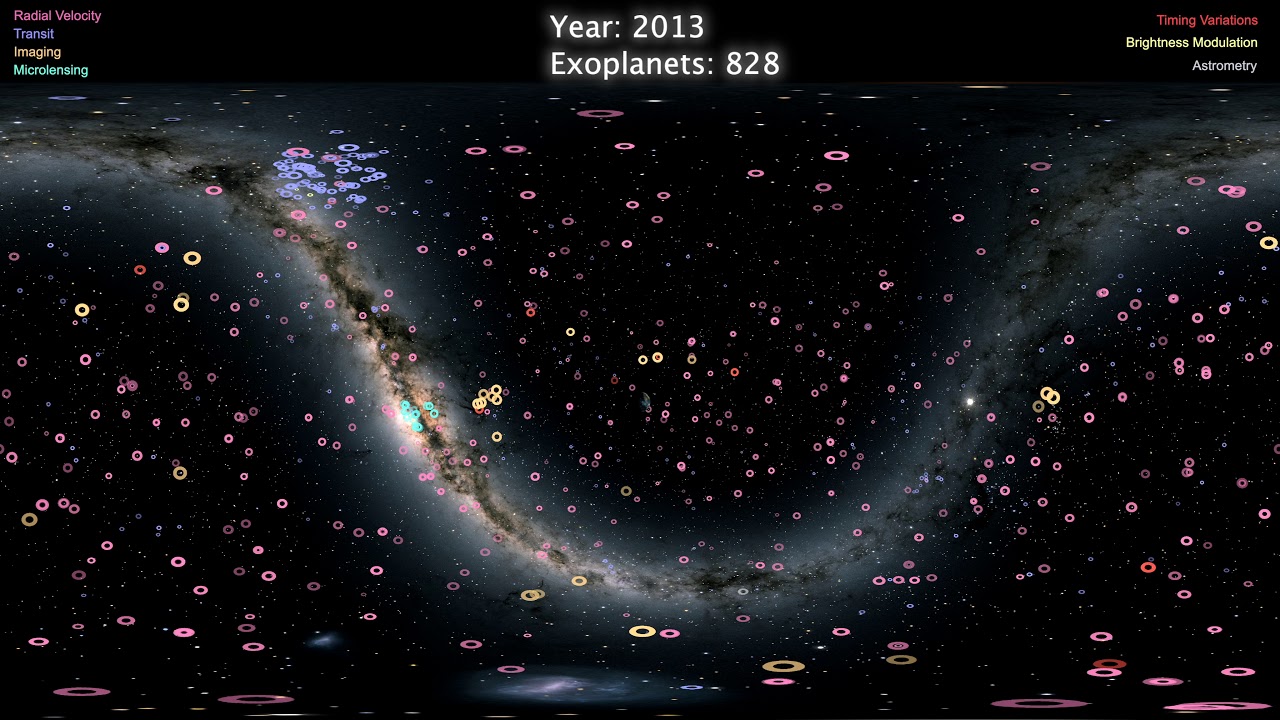
4000 Exoplanets
Video credit: SYSTEM Sounds (M. Russo, A. Santaguida) Data: NASA Exoplanet Archive Details: https://apod.nasa.gov/apod/ap190710.html
Reproduzir vídeo
Reproduzir vídeo
01:37
Rocket Launch as Seen from the Space Station
Credit: NASA, ISS, Riccardo Rossi (ISAA) Music: Inspiring Adventure Cinematic Background by Maryna Details: https://apod.nasa.gov/apod/ap181126.html Comments: http://asterisk.apod.com/discuss_apod.php?date=181126 Attribution: NonCommercial-ShareAlike 4.0 International License
Reproduzir vídeo
Reproduzir vídeo
02:35
Illustris Simulation of the Universe (w/ music)
Credit: NASA, Harvard CfA, Illustris Collaboration http://www.cfa.harvard.edu/imagelist/2014-10
Ver mais
bottom of page